
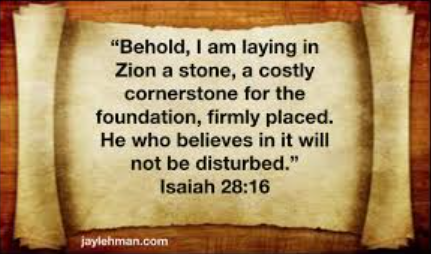
There appears to be some confusion in regard to some of the scriptures where they appear to overlap to such a point that we have all just given up and call Jesus the Foundation and the Cornerstone. If we very carefully examine the scripture, it is possible to separate the different definitions so that we don’t have to conglomerate them into one category. We’ll begin with 1 Corinthians 3:11-13,
”For no other foundation can anyone lay than that which is laid, which is Jesus Christ. Now if anyone builds on this foundation with gold, silver, precious stones, wood, hay, straw, each one’s work will become clear; for the Day will declare it, because it will be revealed by fire; and the fire will test each one’s work, of what sort it is.”
Before we begin, what is the fire? It’s a test. Alright now begin, as we can see between these two verses, and some verses later, what is being said, is that Jesus is the one who is laying the foundation. It may ever so slightly imply that He is the foundation, but later we will see that He is just laying it and not the foundation itself. Another way of saying this is that Jesus is our Architect and Designer, He is the one who is holding the blueprints or the plans. It becomes a little clearer as we move up to Ephesians 2:20-22,
” having been built on the foundation of the apostles and prophets, Jesus Christ Himself being the chief cornerstone, in whom the whole building, being fitted together, grows into a holy temple in the Lord, in whom you also are being built together for a dwelling place of God in the Spirit.”
Here one can clearly see that it is stating that the foundation are the apostles and prophets. So, up until this point we can separate the One from who is laying the foundation from who or what is the foundation. Where some of the confusion is coming into the most play is in the definition of who is the First cornerstone. In the previous verse, it is stating that Jesus is the cornerstone, but we don’t necessarily want our architect to also be the resource for constructing the building. Before I move to show the issue with this verse, let me first diffuse the other assumptions that are verses that are theoretically pointing to Jesus to be this chief cornerstone. They are 1 Peter 2:5-7,
”you also, as living stones, are being built up a spiritual house, a holy priesthood, to offer up spiritual sacrifices acceptable to God through Jesus Christ. Therefore it is also contained in the Scripture, “Behold, I lay in Zion A chief cornerstone, elect, precious, and he who believes on Him will by no means be put to shame.” Therefore, to you who believe, He is precious; but to those who are disobedient, “The stone which the builders rejected Has become the chief cornerstone,”
If we temporarily break ourselves of thinking of all of these connections as being a group of related proofs and examine each instance one at a time, we can retain our logic to a new conclusion. In just the examination of this verse, we can see that Jesus isn’t necessarily being stated as the cornerstone, this verse is stating that sacrifices are being offered through Jesus Christ as “living stones.” This goes right back to Jesus being the Architect analogy. We can also see this in that Jesus is the Chief Mediator, mediator is another word for one who is coordinating, such as that of an architect or designer.
Also, a bit off topic but important to examine, is that the author of Ephesians was most likely not Paul. Particularly, chapter two has some issues, and the churches use the Book of Ephesians to make many of their theories work. What I have found is that much of the New Testament is a “refining” of the Old Testament by the New Testament authors. So, the author of Ephesians believes that Jesus is the Messiah. This is exactly why it is assumed that Jesus is the Chief Cornerstone because the Messiah is the Chief Cornerstone. In other words, here is the logic. The Messiah is the cornerstone, Jesus is the Messiah, therefore Jesus is the cornerstone. The logic should be that the Messiah is the cornerstone, because that is what we know. It’s an assumption that Jesus is both the Messiah and the Cornerstone.
I believe that the other “delusion” here is that because the cornerstone is being called precious that we infer that it must be speaking of Jesus, but in assuming that, we are right back where we started again. The circular argument that we never figure out. As stated earlier we must re-train our brains to not think of all of these things as a whole. The whole is the building that is being built on the foundation, with the stones and corner stones being coordinated by the Architect. So, if we can allow ourselves to not to have to think that this cornerstone is Jesus, then we can move on to the next point. Matthew, Mark, and Luke are pretty much sharing the same verse, so let’s just focus to our next point on Matthew 21:42-43,
Jesus said to them, “Have you never read in the Scriptures: ‘The stone which the builders rejected has become the chief cornerstone. This was the LORD’s doing, and it is marvelous in our eyes’? “Therefore I say to you, the kingdom of God will be taken from you and given to a nation bearing the fruits of it.”
Here again, Jesus isn’t stating that He is the cornerstone. He is quoting scripture from Psalm 118:22. Unfortunately, I have to diverge my argument here to emphasize how this isn’t necessarily speaking of Him being the cornerstone. As said earlier, that it isn’t said, nor it is implied, that Jesus is stating that He is the cornerstone. Our minds keep wanting to put all of these “proofs” together to keep coming back to the conclusion that He is the cornerstone. Let’s examine this verse separately as well by examining the context of the entire verse of Psalm 118.
The first thing that I would do is to identify that if this chapter appears to be speaking of the same person through its entirety. Is it being consistent with the thought? We can conclude that yes, it is. It does not appear to go off on some other tangent to another subject, but it appears to be solely focused on one subject or person. If that be the case, then we must take the entire verse into context of the reference from Matthew 21. So, with that out of the way, we’re going to go through the verse to look for things that don’t appear to be speaking of Jesus. The first place that we come to is Psalm 118:5,
”I called on the LORD in distress; the LORD answered me and set me in a broad place.”
This is speaking of a person who is crying out for help who is distressed. Then after he calls out, the Lord answers him and sets him in a “broad” place. The broad place is represented as the wide gate that everyone is at. Another way of stating this is that God set him in a lukewarm place. It’s not the narrow gate, but a place where he has a chance to prove himself. We can see more of a clue in the very next verse where it says,
Psalm 118:6, ”The LORD is on my side; I will not fear. What can man do to me?”
Can we imagine Jesus stating or thinking either the words from verse five or verse six? Jesus calls the LORD, Father. Then it is stated, what could man do to me? If we are speaking of Jesus, they could put him up on a cross and stake nails through his hands. The person in this verse is expecting to remain alive in the flesh. The person here most likely has already endured their inflictions and feels that there isn’t anything else that men could do to him with the LORD on his side. We can see more in verse seven,
Psalm 118:7, ”The LORD is for me among those who help me; therefore, I shall see my desire on those who hate me.”
I probably don’t have to state the obvious, but I’m going to anyway. This in no way sounds like something that Jesus would say. It is speaking of vengeance with the help of the LORD and Jesus has stated that He did not come to judge but to educate. We could go on for other reference but to mitigate the length of this article, let’s move on. Acts 4:8-12 appears to be a confusing verse, and we will have to study it for a bit here, but we have already laid our own foundation to understand this in context. So, let’s read this verse as thus,
”Then Peter, filled with the Holy Spirit, said to them, “Rulers of the people and elders of Israel: If we this day are judged for a good deed done to a helpless man, by what means he has been made well, let it be known to you all, and to all the people of Israel, that by the name of Jesus Christ of Nazareth, whom you crucified, whom God raised from the dead, by Him this man stands here before you whole.
Psalm 118:22 (paraphrased), ‘This is the stone which was rejected by you builders, which has become the chief cornerstone.’
Acts 4:12, “Nor is there salvation in any other, for there is no other name under heaven given among men by which we must be saved.”
I believe that the first thing that we must do is to examine this is attempt to look at the context in which it is being applied. Apparently both Peter and John are on trial, and their audience are the Jewish leaders. So, they would have been under a lot of pressure when this was stated, and they were most likely trying to impress the weight of the decision that the Jewish leaders were making on them. The focus of the question was on verse seven,
Acts 4:7, ”And when they had set them in the midst, they asked, “By what power or by what name have you done this?”
To answer the Jewish leader’s question, their answer did not need to make sense in regard to the punishment or conviction, but to state that they were supporting a cause that was of God. The cause that was being supported, was the construction of the building for the Temple of God, and that they were following the orders of the Architect (Jesus). If we try to break this down to mean any other thing, it never comes to any point that makes sense. For example, it could be implying that Peter himself is the cornerstone, which most likely isn’t true. If it is stating that Jesus is the cornerstone, then what does that have to do with their trial?
What it leads back to is that Peter and John were supporting a cause that was associated with Jesus’s plan. Somehow what Peter said works, and the Jewish leaders are amazed at the words that they spoke. I’m sure there was some divine intervention there. When they quoted Psalm 118 it wasn’t to say that either Peter, John, or Jesus was the cornerstone; they were using it as prophetic evidence that a building was being constructed and that they are following Jesus’ plans to fulfill that construction. That then answers the question that the Jewish leaders were asking from verse seven. As to what the word “whole” meant in verse ten, I could only imagine that it was to state that they were not ashamed of what they had done and that there was no guilt to be had as in “not being the complete truth, ” the task was wholesome or complete.
If we try to look at this from any other perspective other than for the reason that Peter was answering the question that was asked of him, then we are simply looking at the literal values of what was said that could imply either Peter or Jesus to be the cornerstone, but that that would not be in the context of answering the Jewish leaders question. Again, this is a matter of having to reference the subject into a grander context. As that John had reprimanded Peter’s actions a few times in the past, one is tempted to go back in time to do something similar for answering the question like this, but apparently it worked for them.
Now after all of that, we can come back to Ephesians 2:20 where it appears to emphatically represent Jesus as the cornerstone. Some of you may not like this, but hands on cheek and mouth opened wide, the Textus Receptus may not be entirely accurate. Which of course is where we get most of our modern translations from. I first deferred to the Codex Sinaiticus, and I will quote the literal Greek text as thus Ephesians 2:20,
”εποικοδομηθεντεϲ επι τω θεμελιω των αποϲτολων και προφητων οντοϲ ακρογωνιαιου του χυ”
As some of you may know just enough Ancient Greek to see that the “Nomina Sacra” for the word Jesus isn’t in there. “A few documents, including [179] , omit Ἰησοῦ (William, R 1875) .” “[179] Codex Sinaiticus (sæc. iv.), now at St. Petersburg, published in facsimile type by its discoverer, Tischendorf, in 1862 (William, R 1875).” The verse that was quoted from above, is from the online https://codexsinaiticus.org. The word Messiah or Christ is represented by the last word “XU.” Christos or Christ in Bibles like the NKJV are implied to mean either Jesus or the Messiah, “anointed one” more specifically. If one must contest that Jesus is also a Messiah, then what we are speaking of is the promised Messiah that was hoped for by the Jews under the first covenant. The theory here is that this Messiah is being represented, as the Hebrew King Messiah and that the translator messed up in more than one location in Ephesians. This makes more sense in the context as well, being that it is stating that the building is being built “…on the foundation of the apostles and prophets, …” This is again stating that the foundation are the Apostles and Prophets.
So, at this point let’s take inventory of what we have. We have the Apostles and Prophets being the foundation, and we have the Architect, Mediator, Orchestrator as being Jesus Christ. The only thing left is who is the cornerstone. Now somehow, we have to keep two theories separate while we diagnose this. There is the camp who doesn’t believe that there is another Messiah except Jesus, and there is the camp that believes that there are two Messiahs with Jesus being the Chief Mediator of both this covenant and of God’s Temple that is being built, but that the Hebrew Messiah is the Promised One. Let’s then attempt to tackle this logically within the boundaries of both contexts or either possibility being true.
First of all, I want to clearly state that it was not the intention of this paper to prove the existence of the other Messiah, but to create logical definitions of what the difference was between the Architect, the Foundation, and the Cornerstone, but as you can see that when we get to the end of this discussion, that we have a very difficult time in fulfilling all three of those categories without the context of two Messiahs. As in how we are trying to tackle the differences in the definitions of these three entities as being separate but yet a part of the whole, we should also consider this an opportunity to explore what else may be the whole and how this problem might help us to solve an even grander problem.
If we see pieces missing in a puzzle, we don’t say let’s create more pieces, no. We say let’s look for the missing pieces. After all, the Jewish community for thousands of years waited for a King Messiah. It would seem absurd that they would wait that long and then want to kill Him. How did that occur that they were so confident that the Messiah that they were waiting for didn’t look like Jesus? Is it possible it is because He didn’t fit the full definition of what was prophesied? We believe in prophecy, we can see how Jesus fulfilled many of the prophecies, but when it comes to the Jews, they don’t get prophecy?
The Bible is moving across what seems like vast amounts of time for us. We expect to see things in our lifetimes, just like how the Apostles thought that the end times were going to happen in their time. Time hasn’t changed anything we are just like them, the only Messiah that we have seen is Jesus, just like them. Therefore after a few thousand years, we don’t think there is another One to come, but how many prophecies have not been fulfilled in regard to the coming Messiah? Matthew 5:17-18, “Do not think that I came to destroy the Law or the Prophets. I did not come to destroy but to fulfill. For assuredly, I say to you, till heaven and earth pass away, one jot or one tittle will by no means pass from the law till all is fulfilled.” We are no different than are ancestors in that way either, we judge time only by the time that we are in, just like they did. So, let’s back up to Ephesians 2:19,
”Now, therefore, you are no longer strangers and foreigners, but fellow citizens with the saints and members of the household of God,”
Just earlier our contested verse stated that We are the stones of the foundation, but who are going to be the first stones, the first living stones? The Apostles and Prophets can’t be the first stones, because we have already stated that they are the foundation. Predecessors to the building of the building. So, who wants to be the first stone on this new foundation? Don’t be shy. If the stones are you and I, then the stones are us, but who is going to be the first stone? If the Apostles and Prophets were mortals, then would not the stones also be of mortals? The major difference between the foundation and the stones is that the stones are of people who have either died and been resurrected (without decay), or will be given a new Spirit after a spiritual death while being alive, because these stones are for a building that will be in Heaven. So, the first person (mortal) who dies and is resurrected (without decay), or the first one to receive a new Spirit while alive in the flesh, after Jesus is Glorified, will be the first living stone. Hence that person will be the Chief Cornerstone.
Again, if our ancestors are the foundation and Jesus is the Architect, who is going to be the Chief Cornerstone? Alright, I’ll resist the temptation to convince you further and will only leave you with the mystery…
Citation:
Codex sinaiticus – see the manuscript: Ephesians. Codex Sinaiticus – See The Manuscript Ephesians. (n.d.). https://codexsinaiticus.org/en/manuscript.aspx?__VIEWSTATEGENERATOR=01FB804F
William, R. R. (1875). Ephesians 2 – the expositor’s Greek testament – bible commentaries. StudyLight.org. https://www.studylight.org/commentaries/eng/egt/ephesians-2.html
